How to Write a Eulogy Speech
Once the transition of death occurs, it may become the responsibility of the spouse, child, friend or clergy, to compose and deliver the eulogy. The eulogy speech is the "sending off" message, the "funeral praise" or the oral memorial given in honor of someone who has died. The Eulogy may also be in written form, and can be included in funeral programs and other memorial keepsakes. Being asked to undertake this task is a great honor and symbolizes the trust and love the family members have for you, the Eulogist. It can also be a difficult experience to be asked to give an eulogy as you are recalling memories that are personal and deep to your heart.
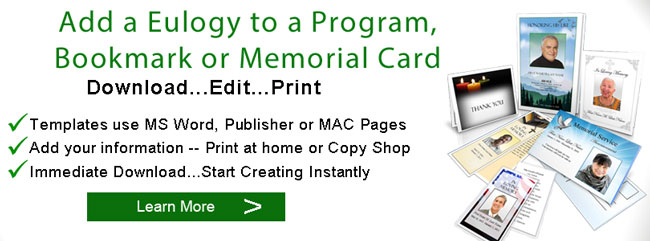
The eulogy itself can be delivered in a varieties of ways. It can be somber, witty or humorous, brief or lengthy, deeply personal or very generalized. It may be helpful to check with the deceased's family to ask what the general "tone" and format of the service will be. You may also ask about the service venue. Will the service be in a church or chapel, or in a town hall, pub or other secular venue. You should also consider giving a brief and general overview of what you plan to say in your eulogy to family or clergy.
The eulogy can contain a chronicle of the deceased life history, shared memories between family and friends, a reflection of the deceased person's legacies, personal achievements. It may also include details about family, friends, career, and hobbies. Just as no two people are exactly the same; neither do any two eulogies perfectly echo one another. Their content and delivery vary widely based on factors such as nationality, culture, religion, values, personality and traits of those involved.
General Eulogy Template
Eulogy Introduction and Opening Statements
Things you may want to include:
-
Introduce yourself and explain your relationship to the deceased
-
Thank guest for attending the services, acknowledge guests that have traveled to attend
-
Express condolences to family members and close friends of the deceased
Talk about the special qualities and characteristics of the deceased.
This will be the longest part of the eulogy.
-
Tell about special and distinguishing characteristics of the person
-
Tell of stories that happened between you, or other family and friends of the deceased.
-
Talk about their goals and ambitions
-
If the person being honored is religious, give examples of that person's faith and comittment to church
-
Tell what you learned from that person...describe what they taught others.
-
Discuss personal achievements, special talents, hobbies, interests or life passions
Offer uplifting and comforting thoughts to the audience
-
A favorite funeral or memorial poem
-
A favorite quote, saying or song
-
Read a passage from the bible, or a favorite author of the deceased that is suitable for the occasion
Give Closure
-
Summarize your speech
-
Say goodbye to the deceased (directly or indirectly)
Eulogy Examples
When it comes to writing eulogies, the options can be limitless. A eulogy can be funny, sad, serious, lighthearted, or any other syle or tone that you may think appropriate. When writing and giving a eulogy, keep in mind the personality and demeanor of the person being eulogized, and let the eulogy reflect that. You may also consider the venue or location of the service. Here are a few examples of what you can do.
Eulogy Example 1 -- Father
Losing my Father is one of the most difficult things I have gone through. As I am standing up here today, I realize how fortunate I was to have him as my Father. There are not words to express his influence in my life. It is through his example that I learned to be the father and husband that I am today. My father was hardworking, strong, loving, and gentle. He loved his family and was deeply devoted to my mother and three siblings. However, he was no saint by any means or stretch of the imagination. SEE MORE Eulogy Templates>>
Eulogy Example 2 -- Mother
What can I say about my Mom? For those of you that knew my mom, she was not only the life of the party but often the reason for the party. She use to always say to us "Don't be so serious, life is too short, just have fun". In her late 30's, Mom was diagnosed with Parkinson's disease. As some of you may know, Parkinson's disease affects the brain and muscular control of the person that has the disease. I remember when Mom was diagnosed over 15 years ago, she was firm, gentle, hopeful, yet well aware of the way her life was changing. SEE MORE eulogies for Mothers>>
Composing and delivering a eulogy can be huge task. Do not be afraid to ask for help. Going it alone in difficult and sorrowful situations may prove to be far more stressful on your emotional well-being than necessary. Sharing the burden of composing a eulogy may go a long way to reducing the heavy burden you bear. Don't be afraid to ask friends and family members for stories and information to help you deliver the best eulogy you can.
Make the Perfect Funeral Programs...It's Easy
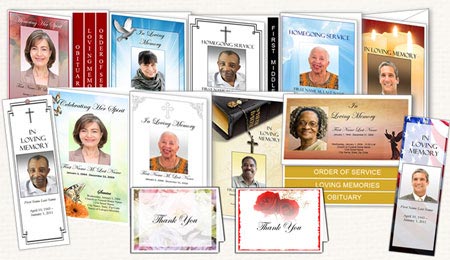
- Professional Designs formatted using Microsoft Word or Publisher
- All test can be changed, including the program title
- Flexible Designs and Layout
- Instant Download and Live customer support
Also see Eulogy Examples:
Eulogy Examples
Sample Eulogy for Mother
Sample Eulogy for Father
Sample Eulogy for Grandmother
Eulogy Writing Guide (Checklist)